
A Lesson in Interpretation
One of the most basic principles of interpretation involves placing something within its appropriate temporal context—its setting in time. The principle applies to observing tracks in the sand, geological formations, and a text of Scripture. The verb dechronologize refers to this specific interpretational step.
- de- = “the undoing of, or reversal of”
- -chron- = “time”
- -o- = connecting vowel in word construction
- -log- = “study of, or systematic arrangement of, or account of”
- -ize = “make into, or subject to”
Therefore, to dechronologize can mean to take what seem to be an out-of-the-order set of clues to reorganize into an accurate timeline. (It can also refer to stripping away the chronological order to examine each piece of evidence individually.)
If we come upon a set of footprints in the sand that shows multiple sets of tracks sometimes overlapping one another, it is possible to establish a timeline representing the sequence for the overlapping trackways.[1]
We can tell in the first set of trackways that the ones proceeding straight ahead were laid down after the ones proceeding from left to right. How? The later set overlaps and partially obscures the earlier set. In the second example the rear foot over-prints the front foot, showing the time sequence: front foot planted first followed by the rear foot planted atop part of the front footprint.
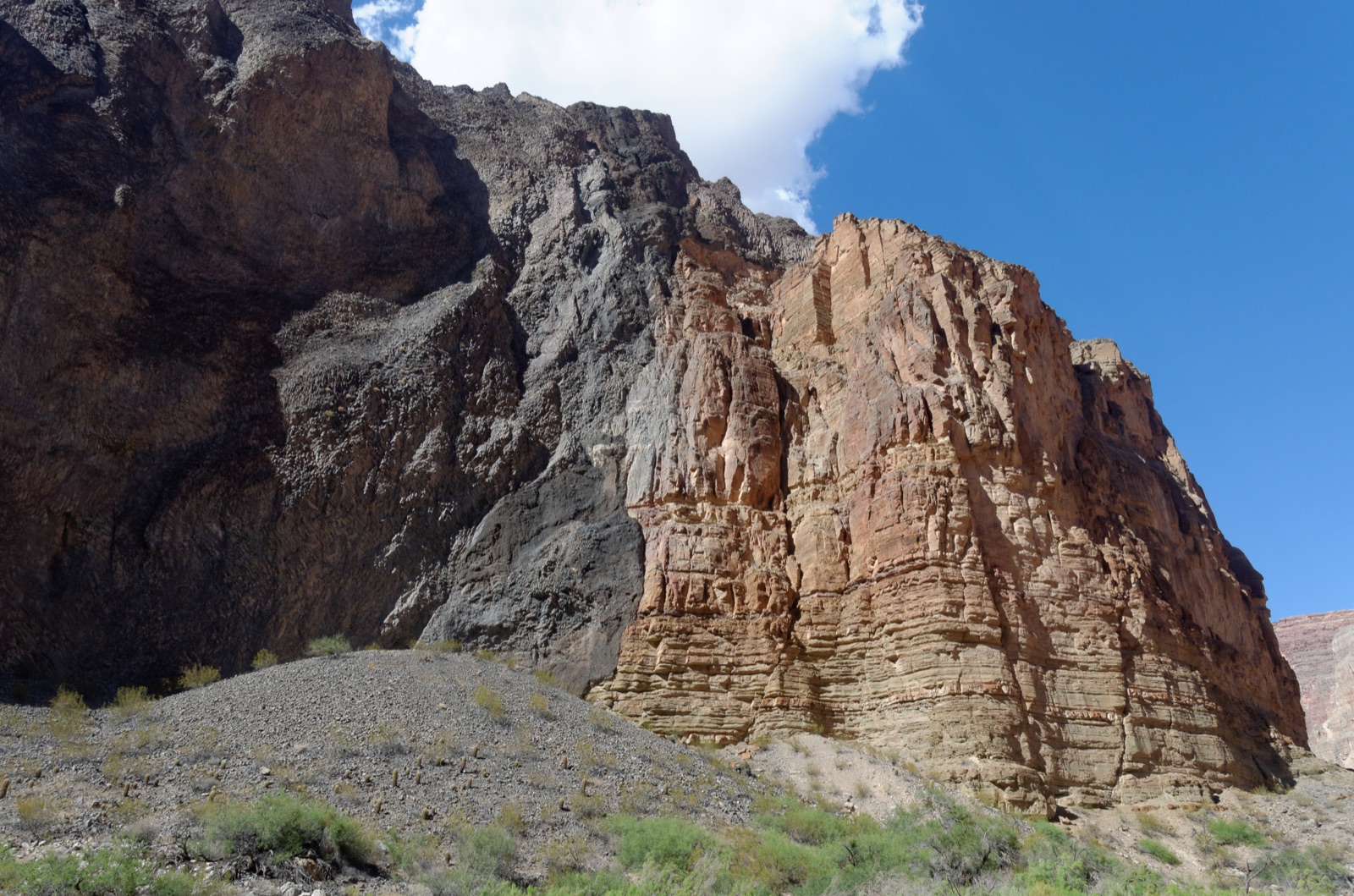
Another example involves lava flows in western Grand Canyon. From river level many remnants of lava flows can be viewed along with their abundant columns of basalt.
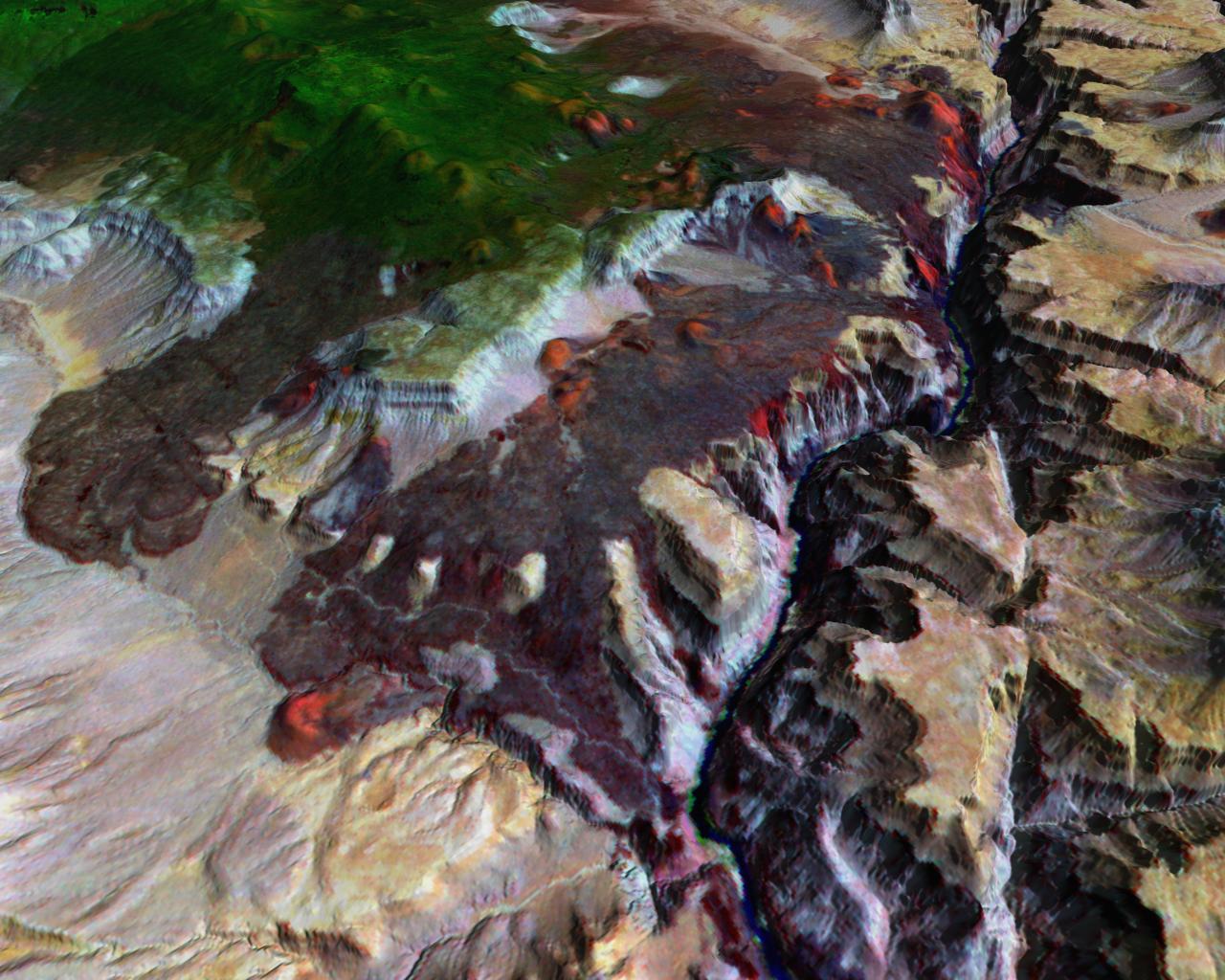

At about river mile 183 rafters looking on river right can see the lava blocking the original channel of the canyon (see this post’s lead photo). Today the river flows around the sedimentary column of layers on the south side of Buried Canyon in a new channel cut around the blockage by the ultimate burst of water following the failure of the lava dam blocking the river. On river left remnants of lava flows can be seen clinging to the sedimentary cliffs inside the channel. So, what is the chronological sequence presented by the evidence? First, the lava flow blocking the main channel (Buried Canyon). Second, the bursting of the river through the alternate channel it cut to get around the blockage (current river channel). Third, the later flows of lava into this new channel.[3]
Both of these examples represent what is known as relative chronology. The observer determines the sequence of the various pieces of observable evidence in relationship to one another in order to obtain a full picture of the sequence of events represented by the evidence.
Now, let’s apply this principle to a passage of Scripture: Genesis 2:10–14. Verse 10 in Hebrew reads, וְנָהָר֙ יֹצֵ֣א מֵעֵ֔דֶן לְהַשְׁק֖וֹת אֶת־הַגָּ֑ן וּמִשָּׁם֙ יִפָּרֵ֔ד וְהָיָ֖ה לְאַרְבָּעָ֥ה רָאשִֽׁים (wənāhār yōṣēʾ mēʿēden ləhašqôt ʾet-haggān ûmiššām yippārēd wǝhāyâ lǝʾarbāʿâ rāʾšim). The first verb is the participle יֹצֵא (yōṣēʾ), which, like all Hebrew participles, derives its tense from the context. Since the event is in the far past and embedded in the creation narrative of Genesis 2–3, “was going out” or “was flowing” makes good sense. However, some English versions translate it as a present tense. One version that does so is the NET Bible,[4] “Now a river flows from Eden …” A translation note in the NET Bible explains the choice of the present tense as follows:
The Hebrew active participle may be translated here as indicating past durative action, “was flowing,” or as a present durative, “flows.” Since this river was the source of the rivers mentioned in vv. 11–14, which appear to describe a situation contemporary with the narrator, it is preferable to translate the participle in v. 10 with the present tense. This suggests that Eden and its orchard still existed in the narrator’s time.
Such a viewpoint suggests that the translator(s) either chose to keep the timeframe contemporary to Moses as the writer of Genesis or did not believe that the Flood of Genesis 6–9 consisted of a global, catastrophic cataclysm. Readers are left with the impression, however, that the river still exists and can be located and visited today. However, if one believes, as I do, that the Flood of Noah’s time was indeed global and catastrophic, then we do not want to leave readers with an impression contradicting that historical event and that they might find Eden today on the face of the earth.[5] Since the Flood occurs at least 1,656 years (years after creation of Adam for Methuselah’s death) after God placed Adam in the garden of Eden, the relative chronology requires the participle be taken as a past tense and we come to the following translation: “A river was flowing from Eden to water the garden.”
According to the second half of Genesis 2:10, “and from there it was divided so that it became four headwaters” (ûmiššām yippārēd wǝhāyâ lǝʾarbāʿâ rāʾšim). The use of “from there” indicates an established point of reference: the garden of Eden. The verb yippārēd (“it was divided”) takes the river (nāhār, the primary noun in the first half of the verse) as the grammatical subject (“it” = “a river”). The next Hebrew verb, wǝhāyâ followed by the lamed-preposition (lǝ), takes on a dynamic stative sense: “became.”[6] That implies the river began as a single body of flowing water in the garden of Eden, but with “from there [the garden of Eden]” preceding it the dividing might have taken place outside the garden where the single flow “became” four separate rivers. In other words, as the text indicates, the initiation of the four different flows comprise “four heads” or “four headwaters.” What the text describes would have been similar to what we see with the Nile River in Egypt that divides into two separate streams (branches), the Rosetta (Rashid) Branch and the Damietta (Dumyāṭ) Branch that empty into the Mediterranean Sea. Again, a relative chronology indicates that the river is first one stream and afterwards four streams providing the heads of four different rivers. In the present time Wollaston Lake in Saskatchewan feeds two rivers, the Fond du Lac and the Cochrane (the first ends up in the Arctic Ocean, the second ends up in Hudson Bay). Such an example demonstrates that the different rivers out of a single stream may not end up in one river’s delta like the Nile. Thus, the rivers of Eden might not have flowed into the same sea (though we have no idea of the number of seas extant on our pre-Flood planet).
Verses 11 and 12 must continue the use of the past tense to describe the first river and the land around which it flowed. “Havilah”[7] (חֲוִילָה, ḥăwîlâ) appears next in the Bible as the name of a son of Cush (Genesis 10:7) after the Flood. Then the same name is given to a son of Joktan (Genesis 10:29). Its multiple uses indicate that the descendants of Noah liked the name they had brought with them out of the pre-Flood world in which they had lived. If a reader or translator believes the Flood of Noah’s day was indeed a global catastrophe, the name will not be taken as identical to any post-Flood land. Therefore, the Havilah of the descendants of Ishmael (Genesis 25:18) is not a land where anyone might go today in order to find the gold existing there in the pre-Flood world. That land is buried under an immense amount of sedimentary rock layers deposited by the Flood.
In verse 13 “the land of Cush” (אֶרֶץ כּוּשׁ, ʾereṣ kûš) should not be translated as “the land of Ethiopia” since Ethiopia did not exist at the time of the garden of Eden. It is an unknown land whose name was applied in post-Flood times (cf. Genesis 10:6–10) to either Ethiopia or the land of the Kassites.[8]
Verse 14 presents four more opportunities to apply the principle of dechronologization. First, the verbs should continue the past tense already determined starting with verse 10. Second, the name of the third river, “Hiddeqel” (חִדֶּקֶל, ḥiddeqel), occurs only here and in Daniel 10:4. Third, the name of the land east of which the Hiddeqel was flowing: “Asshur” (אַשּׁוּר, ʾaššûr). Fourth, the fourth river’s name, “Perat” (פְּרָת, pərāt). The last three names have been individually applied to the Tigris River,[9] the nation of Assyria,[10] and the Euphrates River,[11] respectively.
The next biblical mention of Asshur comes in Genesis 10:11–12 where it occurs as the name of the individual who built the cities of Nineveh, Rehoboth, Calah, and Resen. He was a son of Shem (Genesis 10:22). Asshur must have been born after the Flood, since there were only eight persons in the ark including his father and mother. Perhaps Shem named him for the pre-Flood land bearing the same name. Asshur’s name was later applied to the nation containing the cities he had founded: Assyria.
The next reference in Scripture to the river Perat comes in the time of Abraham (Genesis 15:18) in Yahweh’s description of the land to be settled by Abraham’s descendants. It does not occur again in the Bible until Moses speaks of the River Perat/Euphrates as one of the boundaries of the land Yahweh had promised to give to Abraham, Isaac, and Jacob (Deuteronomy 1:7).
So, why did the post-Flood people re-use the names of pre-Flood rivers and lands? Like many displaced peoples who immigrated to other countries, they probably preferred to preserve names as part of their memory of their former homeland. My own distant relatives who came to America from Germany not only retained their language, but also sought out geographical locations reminding them of their homeland. Some immigrants brought names of familiar places with them to America to apply to locations here. Consider the following examples:
- London, Ontario and the River Thames — after London and Thames in England
- Boston, Massachusetts — after Boston, Lincolnshire in England
- Liebenthal, Kansas — after Liebenthal in Russia
- Danube, New York — after the Danube River in Germany
- Maine (state) — after province and river, Maine, France
Throughout the Bible interpreters and translators must dechronologize the text in order to accurately understand and represent their setting in time and space. Sometimes, as with Cush, Asshur, Hiddeqel, and Perat in Genesis 2:13–14, it is best to preserve pre-Flood names in transliteration rather than to attempt to associate the names with how they were later re-used in the post-Flood world. To do otherwise creates confusion for readers and can lead to a denial of later biblical revelation.
Footnotes
[1] The photo references in the following text provide links for accessing copyright-protected photos. By clicking on the links, the reader can access the appropriate website and locate the photo I have described.
[2] Up to thirteen different lava dams have blocked the Colorado River in Grand Canyon in the past. Those dams rose from 200 to 2,300 feet above the river and could back the waters up for nearly 200 miles before finally failing. The dam failures sent additional catastrophic flood waters down through the canyon. See the video at https://www.youtube.com/watch?v=d54WCttuHYM&t=232s (accessed 19 Oct 2026). Note: The distant times cited in the video do not match the far more recent timeline proposed by geologists with a biblical viewpoint.
[3] Cf. Hamblin, W.K., 2003, Late Cenozoic lava dams in the Western Grand Canyon, in Beus, S.S., and Morales, M., eds., Grand Canyon Geology (2nd ed.): Oxford, UK, Oxford University Press, 432p. Ryan S. Crow, Karl E. Karlstrom, William McIntosh, Lisa Peters, Laura Crossey, and Athena Eyster, “A new model for Quaternary lava dams in Grand Canyon based on 40Ar/39Ar dating, basalt geochemistry, and field mapping,” Geosphere 11, no. 5 (2015): 1305–42, https://doi.org/10.1130/GES01128.1 (accessed 19 Oct 2026).
[4] Biblical Studies Press, The NET Bible, 2nd ed. (N.p.: Thomas Nelson, 2019). Other translations using the present tense include The Message (“A river flows out of Eden …”—same as the New Revised Standard Version, NRSV), the Tanakh (New Jewish Publication Society, NJPS: “A river issues from Eden …”), and the New American Bible Revised (Roman Catholic Confraternity version: “A river rises in Eden …”).
[5] The following commentators recognize this aspect of the text: H. C. Leupold, Exposition of Genesis (Grand Rapids: Baker Book House, 1942), 124, “But the extensive changes in the earth’s geography caused by that vast catastrophe, the Flood, have entirely disarranged the old order”; and, Henry M. Morris, The Genesis Record: A Scientific and Devotional Commentary on the Book of Beginnings (Grand Rapids: Baker Books, 1976), 89, “it is more likely that these were rivers of the antediluvian world which do not even exist in the present world.”
[6] Perfect (qatal) of הָיָה (hāyâ) followed by the preposition לְ (lə); see Michael A. Grisanti, “הָיָה (hāyâ),” in The New International Dictionary of Old Testament Theology and Exegesis, 5 vols., ed. by Willem A. VanGemeren (Grand Rapids: Zondervan, 1997), 1:1022.
[7] See “Havilah,” in Baker Encyclopedia of the Bible, ed. by Walter A. Elwell (Grand Rapids: Baker Book House, 1988), 1:932.
[8] See “Cush,” in Baker Encyclopedia of the Bible, 1:561.
[9] See “Tigris River,” in Baker Encyclopedia of the Bible, 2:2062.
[10] The historical nation of Assyria did not exist until the middle of the second millennium B.C.; A. Bernard Knapp, “Mesopotamia, History of,” in The Anchor Bible Dictionary, 6 vols., ed. by David Noel Freedman (New York: Doubleday, 1992), 4:717.
[11] See “Euphrates River,” in Baker Encyclopedia of the Bible, 1:729–30.