
Misunderstood Verses of the Bible

Many Bible passages prove difficult to understand, leading some to question the Bible’s integrity and accuracy. A lack of adequate information can lead to misunderstanding. New information sheds light on the meaning of some difficult verses. Recent scientific and archaeological discoveries or new insights about the original languages of the text itself bring resolution to formerly misunderstood verses.
Believers must be cautious in accepting some new answers to problem passages. When someone comes along with a vastly different and new interpretation of a text, we must imitate the Bereans of old (cf. Acts 17:11). We must check new interpretations and methods of interpretation by considering the input of all Scripture. If someone claims to be chosen by God to reveal some dramatic new proof in the last days, we must treat such a claim with a certain degree of skepticism (cf. 1 Kings 13:1–25) until we have examined all the data with great care.
In the past there have always been some interpreters who correctly understood the “misunderstood verses” discussed in the remainder of this article. They were sometimes in a distinct minority and were strongly opposed by a majority of commentators and theologians. More recent developments or discoveries help to confirm when the minority are correct. The discoveries have not uncovered anything totally new or faith-shaking.
Stars and Sand
While Abram was residing at Hebron in Canaan, God appeared to him in a vision. Abram admitted to God that he was anxious about being childless (Genesis 15:2–3). In response, God took Abram outside his tent and told him to look up at the heavens and count the stars. God said, “So shall your seed [descendants] be” (Genesis 15:5).
Later in Abram’s life (now as Abraham) he stood on Mt. Moriah and the angel of the LORD said to him, “in blessing I will bless you, and in multiplying I will multiply your seed [descendants] as the stars of the heaven, and as the sand which is upon the sea shore” (Genesis 22:17). The New Testament repeats this declaration in Hebrews 11:12.
For centuries some interpreters have thought that the comparison between the stars and the grains of sand was awkwardly unbalanced. They considered the two illustrations non-equivalent expressions. After all, there seems to be far fewer stars than grains of sand on the seashore.
When scientists put the Hubble space telescope into orbit around Earth, it began to provide astronomers with more accurate information about the quantities of stars in the universe. Astronomers now claim that the known universe contains over 100 billion galaxies, each containing at least 200 billion stars.
Astronomer Carl Sagan used an interesting comparison to put the new information into perspective. He wrote, “The total number of stars in the universe is larger than all the grains of sand on all the beaches of the planet Earth.”[1] Thus science confirms the uncountable nature of both biblical measurements.[2]
It took centuries before the knowledge of science caught up with the accuracy of God’s promise to Abraham. Now we understand that God was not exaggerating the number of stars in His creation.
Solomon’s Shields
Some commentators have been incredulous when it comes to the description of Solomon’s wealth and the display of that wealth in the Temple and the royal palace. Scholars have claimed that these narrative accounts dealing with Solomon’s magnificence, wisdom, and wealth have “the ring rather of saga than of sober fact, though the details of the tribute (v. 25) suggests a basis in history.”[3] Another commentator writes, “Their manufacture from alloyed gold is part of the usual exaggeration, since the amount of precious metal cannot correspond to reality.”[4] In other words, the writer of the book of Kings was a bit extravagant in his description of Solomon’s wealth.
Was it an exaggeration to claim that King Solomon made 200 large golden shields weighing 600 shekels each and another 300 shields of three minas each (1 Kings 10:16–17)? Altogether, those shields would have contained nearly two tons of gold. Is it better to understand the description of these shields as manufactured legend like the exaggerations found in some extrabiblical literature? Is it naïve to take the account literally?
To understand the matter of the shields, it helps to look at their entire history. After Solomon’s death, his son Rehoboam succeeded in starting a civil war (1 Kings 12:1–20). The northern ten tribes of Israel seceded under the leadership of Jeroboam, and Judah entered a period of great weakness and vulnerability politically and economically.
Jeroboam had previously taken refuge in Egypt (1 Kings 11:40) when Shishak ruled as pharaoh. Shishak had staged a successful rebellion in Egypt. He was a Libyan noble with aspirations of gaining control of all Asia. He had waited until he could safely raid Jerusalem with its opulent temple and palace. When Shishak attacked Jerusalem, Rehoboam bought the safety of Jerusalem by giving temple and palace treasures to Shishak. Among those treasures were the golden shields of Solomon (1 Kings 14:26–28). Rehoboam replaced those shields with new ceremonial shields made of far less expensive bronze. The use of bronze is significant as we look at other evidence.
Some have pointed to 2 Samuel 8:7 recording David’s capture of golden shields from Hadadezer of Damascus. This seeming parallel, however, reveals an example of how better linguistic information can point to a better understanding of a particular word, V. Philips Long says that the Hebrew šeleṭ (שֶׁלֶט) in 2 Samuel 8:7, “Probably to be understood as ‘bow (and arrow) cases’ …”[5] The Hebrew word for “shield” in 1 Kings 10:16 is ṣinnâ (צִנָּה), the word for a “large shield covering the whole body, standing shield.”[6] The word for “shield” in 1 Kings 10:17 and in 14:26 is māgēn (מָגֵן), a smaller shield. In 2 Chronicles 14:8 [Hebrew verse 7] one group of warriors carries spears and large body shields (ṣinnâ), while another group of warriors carries bows and the smaller shields (māgēn). With all this in mind, 2 Samuel 8:7 should not be used to either support or oppose our understanding of the references to the gold shields in 1 Kings.
In the second century A.D., the traveler Pausanias reported a golden shield that was on display in the temple of Zeus at Olympia. The inscription on the shield reportedly said it was a gift to Zeus for victory in war. Pausanias described twenty-one other gift shields that hung above the columns of that temple. They were an offering made by a Roman general. The Greek historian Herodotus also wrote of a golden shield that Croesus presented to the temple of Apollo in Thebes.
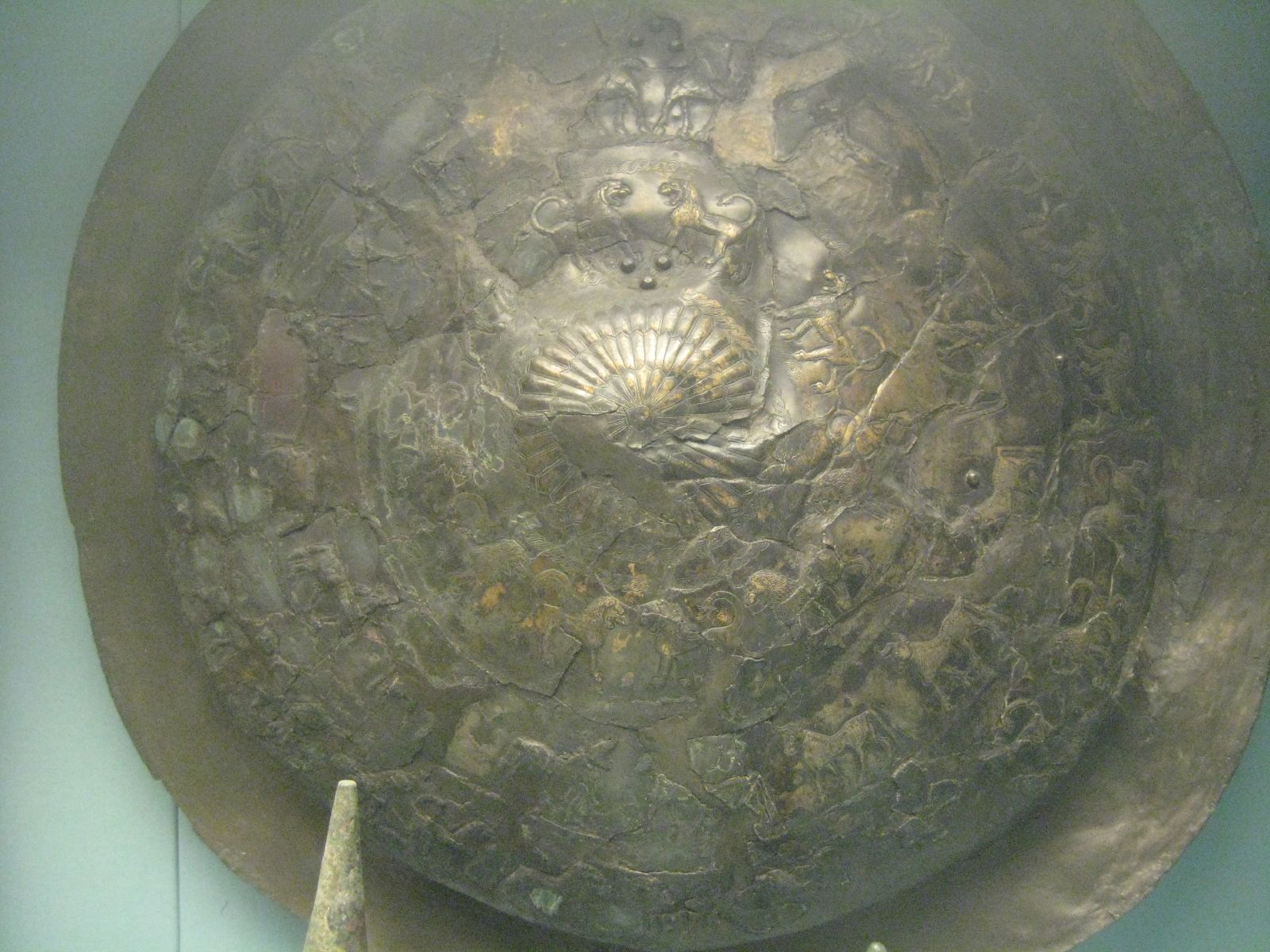
Although no golden shields have been uncovered, bronze examples have been unearthed in Iraq (Nimrud), at Greece (Olympia), Syria (Carchemish), and Turkey (Toprak Kale). Cuneiform inscriptions on some shields at Toprak Kale indicated that they had been dedicated by the Urartian king Rusas. Urartu was an ancient kingdom in control of the region around Lake Van. Russian archaeologists also found an ancient Urartian bronze shield. It was one meter in diameter and had a conical protrusion in the center.[7]
King Sargon of Assyria attacked Urartu in 714 B.C. His armies looted the city of Musasir, southwest of Lake Urmia. A clay tablet with Sargon’s record of the loot was found at the city of Ashur in 1912. The tablet described “6 shields of gold which hung to the right and left of his shrine, gleaming brightly, with heads of fierce dogs protruding from the centers, by weight 5 talents and 12 minas of red gold.”[8]
Those Urartian golden shields weighed about 55 pounds each. Solomon’s larger shields weighed about 15 pounds each. Sargon also left a pictorial representation carved on stone slabs on the walls of his palace north of Nineveh. Surviving fragments of the relief clearly show the shields with a snarling animal’s head on the central protrusion.
It is not surprising that golden shields have not been found. Precious metals were regularly recycled in different forms. Ancient Assyrian records list great quantities of golden vessels, but the first discovery of any golden vessels occurred in 1989 in a tomb at Nimrud.
There is no reason to deny the reliability of the record in 1 Kings 10:16–17. The archaeological evidence resoundingly confirms its plausibility.
An extra insight concerning this passage involves the Hebrew word ṣinnâ for “shield,” the large body shield. There came a time when such shields were discarded for smaller, lighter shields. The larger shield was incompatible with chariot warfare and cavalry. Although the larger shield was phased out, the name of the shield continued to represent full protection. The word is used with that meaning in Psalm 5:12 [Hebrew verse 13] and Psalm 91:4.
The Believer’s Rewards
Approximately 150 years before Christ was born, a man named Peteuris in Egypt wrote a note to someone who had given him assistance. Perhaps the individual helped him obtain a release from military service or from some other obligation. In any case, Peteuris promised the individual that he would receive “by way of reward five talents of copper.”[9] The Greek word he used for “reward” was also used by a correspondent writing to a certain Apollonius. Apollonius had rendered some sort of service to the police in the Egyptian city of Memphis. For his service he was promised a “reward” of three talents.[10]
That Greek word (στέφανος, stephanos) for “reward” occurs eighteen times in the New Testament and is generally translated “crown.” Commentators often take such a “crown” as the laurel or pine wreath traditionally awarded the winners in the Greek athletic contests used metaphorically of an imperishable reward (cf. 1 Corinthians 9:25).[11] Stephanos is also used for the “crown of thorns” placed on Jesus’ head (Matthew 27:29; Mark 15:17; John 19:2, 5).
The New Testament uses stephanos eight times of the rewards that believers can gain (1 Corinthians 9:25; Philippians 4:1; 1 Thessalonians 2:19; 2 Timothy 4:8; James 1:12; 1 Peter 5:4; Revelation 2:10; 3:11). In those passages the rewards that are enumerated include fellow believers (Philippians 4:1; 1 Thessalonians 2:19), righteousness (2 Timothy 4:8), life (James 1:12; Revelation 2:10), and glory (1 Peter 5:4). Those rewards will not perish (1 Corinthians 9:25), although they can be lost or taken away (Revelation 3:11).
The correspondence found in Egypt supports the translation of “reward.” No one would want to wear a copper crown weighing five talents (about 375 pounds)! Life, righteousness, glory, and fellow believers who have come to the gospel through our ministry are not worn on our heads either. The crowns on the 24 elders in the Book of Revelation are not the believers’ rewards (Revelation 4:10). Nowhere are our rewards described as being gold. Golden crowns could be cast at Christ’s feet in tribute, but the eternal life and righteousness that He Himself has given to us cannot be given back.
The New Testament’s usage of stephanos, therefore, would be more clearly understood if the passages speaking of “reward” were so translated according to the common Greek usage of the time.
In conclusion, all three passages’ subjects (stars, shields, and rewards) can be more clearly understood today than in the past. Those better understandings continue to support the inerrancy of Scripture.
Footnotes
[1] Carl Sagan, Cosmos (New York: Random House, 1980), 4, 196. See, also, “Journeys to the Edge of Creation: The Milky Way & Beyond,” Moody Institute of Science (Chicago: Moody Video, 1996).
[2] See an online article by a scientist: Phil Plait, “Do Stars Outnumber the Sands of Earth’s Beaches?” 29 March 2024, https://www.scientificamerican.com/article/do-stars-outnumber-the-sands-of-earths-beaches/.
[3] John Gray, I & II Kings: A Commentary, 2nd rev. ed., Old Testament Library (Philadelphia: Westminster Press, 1970), 262.
[4] Volkmar Fritz, 1 & 2 Kings, trans. by Anselm Hagedorn, Continental Commentary (Minneapolis, MN: Fortress Press, 2003), 123.
[5] As an example of how better linguistic information can point to a better understanding, V. Philips Long, 1 and 2 Samuel: An Introduction and Commentary, Tyndale Old Testament Commentaries 8, ed. by David G. Firth (Downers Grove, IL: IVP Academic, 2020), 342n35, says that the Hebrew šeleṭ (שֶׁלֶט) in 2 Samuel 8:7, “Probably to be understood as ‘bow (and arrow) cases’ …” See, also, Ludwig Koehler and Walter Baumgartner, The Hebrew and Aramaic Lexicon of the Old Testament, rev. by Walter Baumgartner and Johann Jakob Stamm, trans. by M. E. J. Richardson (Leiden, The Netherlands: E. J. Brill, 1994–2000), 1522–23.
[6] Koehler and Baumgartner, The Hebrew and Aramaic Lexicon of the Old Testament, 1037.
[7] Alan Millard, “King Solomon’s Shields,” in Scripture and Other Artifacts: Essays on the Bible and Archaeology in Honor of Philip J. King, ed. by Michael D. Coogan, J. Cheryl Exum, and Lawrence E. Stager (Louisville, KY: Westminster John Knox Press, 1994), 289–91.
[8] Ibid., 291.
[9] George Milligan, ed., Selections from the Greek Papyri (Freeport, NY: Books for Libraries Press, 1969), 4 (Document 2—a papyrus letter from the mid-second century B.C., P. Goodsp. Cairo 5).
[10] Ibid., in the critical commentary notes immediately following Document 2.
[11] Marion L. Soards, 1 Corinthians, Understanding the Bible Commentary Series, ed. by W. Ward Gasque, Robert L. Hubbard, Jr., and Robert K. Johnston (Grand Rapids: Baker Books, 2011), 197.