
Uncommon Wisdom: The Book of Job
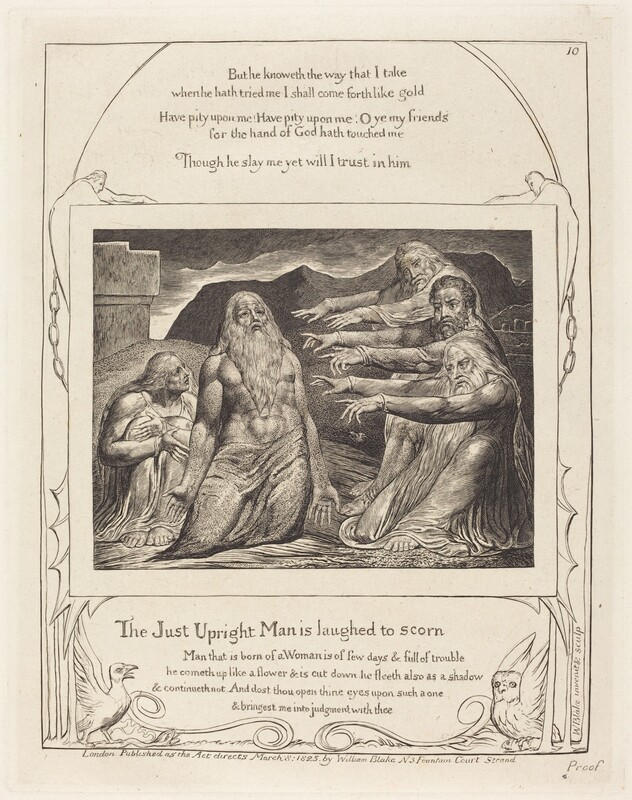
William Blake, Job Rebuked by His Friends, 1825 (National Gallery of Art)
Author: Unknown. Some suggestions include Job himself, Elihu, Eliphaz, Moses, and Solomon. Of these, the mostly likely seems to be Elihu.
Date of Writing: 2100–1900 B.C. — Patriarchal Period. See next paragraph.
Job among the Patriarchs
- Family Conditions (Job 1:1–5). Job was the priest for his own family and the possessor of large herds and flocks. The era of Abraham, Isaac, and Jacob most nearly matches the social setting depicted in the book of Job. The account emphasizes the father’s spiritual leadership. Also, the book does not identify any national structure or setting.
- Historical Conditions (Job 2:11–13; 12:17–25; 22:12–20; 42:11). Job lived a long life that is not possible in the present. From all of this, we understand that Job’s lifestyle had much in common with the lifestyle of Abraham. There are some scholars who would date Job earlier than Abraham. Job lived a nomadic life following grazing sheep, goats, cattle, and camels. Job knew of war (12:17–25; cp. Gen 14). Violence marked the period of the patriarchs. In 22:12–20 the text describes God’s judgment of ungodly men by what could well have been the Flood of Noah’s day. If the reference is to the Flood, that would set the book in the post-Flood era of earth’s history. The term for monetary exchange (qesitah) in 42:11 might set the latest date for the book (cf. Gen 33:19 and Josh 24:32 in which the same term is found and both identified with the time of Jacob).
Job among the Writings
- The Mosaic Period (Job 24:2–11; 42:11). There is no mention in this book of the Jews, the exodus from Egypt, or the Mosaic law.
- The Prophetic Period (Job 12:17–25).
Theme and Subject Matter
The subject matter of the Book of Job is the mystery of man’s suffering and the problem of pain. By means of this book we are able to learn of Job’s patience and of God’s mercy and grace.
Job lived in Arabia to the southeast of Canaan. The Book of Job was written as dramatic poetry in the Hebrew language. The main characters of the book are Job and his four friends (Eliphaz, Bildad, Zophar, and Elihu). Three of these are older friends who in their turn discuss Job’s sufferings with him; but the fourth is younger and insists upon stopping the older men in order to present his opinions. The climax of the drama comes toward the end of the book when God Himself stops all their discussion and speaks directly to Job.
Outline
I. Prose Prologue: Job’s Testing (chapters 1–2)
II. The Dialogue between Job and His Friends (chapters 3–31)
- A. First Cycle of Discussion (chapters 3–14)
- Second Cycle of Discussion (chapters 15–21)
- Third Cycle of Discussion (chapters 22–31)
III. Elihu’s Interruption (chapters 32–37)
IV. The LORD’s Revelation (38:1–42:6)
V. Prose Epilogue: Job’s Restoration (42:7–17)
The Book of Job displays undeniable wisdom associations[1]
- Job’s blameless condition is presented as proof of his wisdom.
- The questions voiced by Job and his friends are deeply philosophical.
- Both Job and his friends demonstrate by their exchanges that they were thinking about life and its meaning.
- The Book of Job appears to be more pessimistic than Proverbs. Job’s three friends reiterate many truths also given in Proverbs. “One can interpret the conflicting themes of Job as evidence that wisdom is a balance between questioning and orthodoxy.”[2]
- The main focus of the book is only mankind’s condition.
- A number of proverbial expressions are found in the Book of Job: 2:4 (“skin for skin”); 19:20 (“escaped with only the skin of my teeth”).
- Theocratic justice is a prominent theme.
- References to “gate” indicate a specific ancient social setting involving the location of wise men who answered the questions of the general populous: 5:4; 29:7; 31:21
Footnotes
[1] Berry, An Introduction to Wisdom and Poetry, 141.
[2] Ibid.